One Week Out: Screen Room, Pool Enclosure, or Patio Cover — Which One Gets Your Backyard Labor-Day-Ready Fastest
One Week Out: Screen Room, Pool Enclosure, or Patio Cover — Which One Gets Your Backyard Labor-Day-Ready Fastest
Here's the honest answer before the comparison: if you're calling this week hoping to have a screen room, pool enclosure, or patio cover fully installed by Labor Day, none of the three gets there. Every one of them requires an engineer-sealed permit under the Florida Building Code, and on the Emerald Coast that step alone typically runs two to six weeks before construction even starts. What one week out actually determines isn't which structure goes up by Monday — it's which one gets you into the queue first for a backyard that's ready well before next season.
This is the second piece in a four-part series on getting a Fort Walton Beach-area backyard ready for Labor Day. The first post covered why an open yard is already working against you two weeks out.
The honest timeline: why none of these go up by Monday
Every permitted aluminum structure on the Emerald Coast — screen room, pool enclosure, or patio cover — has to be engineered and sealed to the Florida Building Code's wind-load requirements before a county will issue a permit. That's not a sales pitch; it's the same requirement a directly competing Emerald Coast builder lays out on its own site: permitting for a pool enclosure typically runs two to six weeks, followed by two to four weeks of construction, for a total project timeline that rarely lands inside seven days. Screen rooms and patio covers go through the identical engineering-and-permit sequence, since the wind-load requirement attaches to the structure type, not to which one happens to be smaller.
That's worth saying plainly, because "which one can you install fastest" implies one of the three has a shortcut. None does. The honest version of this comparison isn't about speed — it's about which structure solves the actual problem on your property, and getting the paperwork moving now instead of after the holiday.
So what does one week out actually get you?
Three things, none of which are a finished structure by Monday: a design consultation and firm scope while your yard's actual problem — sun, bugs, or both, from the first post in this series — is fresh; a permit application filed before the post-hurricane-season demand spike that typically follows Labor Day across the Panhandle; and, if budget is the open question, a financing conversation started now rather than after a quote arrives. Per ABS's own site, the company works with Lyon Financial, a home-improvement-specific lender, through a dedicated application link — worth knowing before assuming a project has to wait for cash in hand.
Screen room or sun room: bugs out, airflow in
A screen room encloses a patio or lanai in mesh, which is the direct answer to the love bug and mosquito timing this series' first post covered — it keeps insects out while keeping the space open to airflow. It does not stop rain; mesh is a filter, not a barrier. A sun room variant with solid or acrylic panels can add weather protection, at the cost of some of that open-air feel.
Pool enclosure: the one with a legal job to do
A pool enclosure does everything a screen room does — bugs out, airflow in, no rain protection — but around a pool specifically, where Florida's residential pool safety law requires some form of code-compliant barrier. A properly engineered and permitted pool enclosure can satisfy that requirement directly, which is a second, non-cosmetic reason it exists beyond keeping the water clear of debris and insects.
Patio cover: shade and rain, no bug control
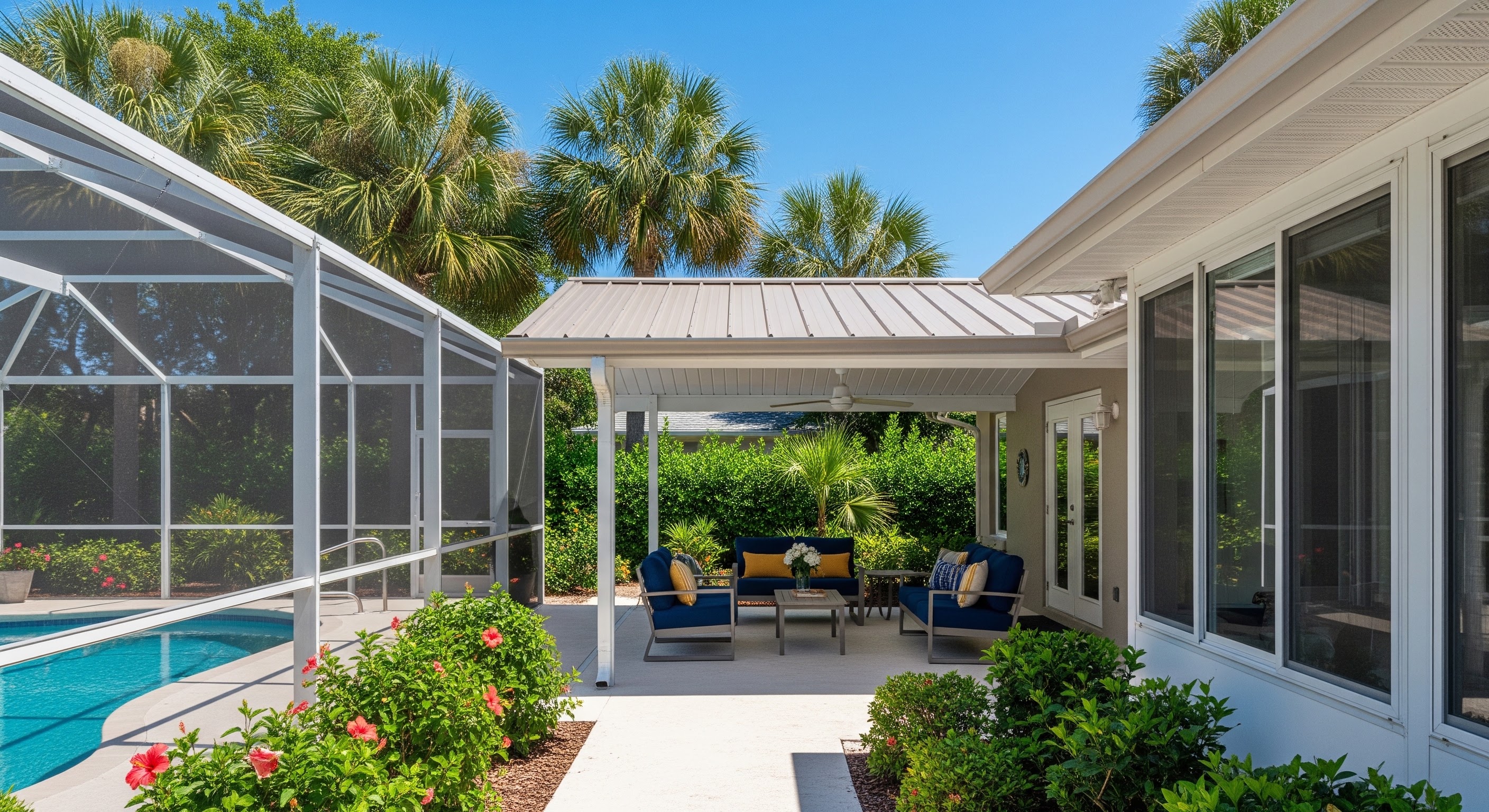
A patio cover is a solid aluminum roof over an otherwise open-sided space — the direct answer to the cumulative sun exposure this series' first post described, and effective against rain as well, since it's a real roof rather than mesh. What it doesn't do is anything about insects, since the sides stay open. It still requires the same engineer-sealed wind-load permit as the other two — being open-sided doesn't exempt it.
On cost: ABS doesn't publish fixed pricing on any of its three product lines, so an exact number requires a quote. For general context, other Emerald Coast builders publish rough ranges publicly — one competitor's 2026 pricing guide lists pool enclosures from roughly $15,000 to $45,000 depending on size and complexity. That's a regional benchmark from a different company's published numbers, not an ABS quote, and actual cost depends on the specific property.
None of the three has a shortcut through the permit process. The only real head start available this week is starting it.
What the sources above don't settle: exact permit turnaround for any specific property, since it depends on the individual county's current workload and the project's own complexity — the two-to-six-week figure is one competitor's published estimate for the same broad region, not a guarantee for any particular ABS project or address.
If you're not getting a new structure before Monday
Most people reading this a week out from Labor Day are hosting with whatever's already in the yard, and that's a completely reasonable place to be. The next piece in this series is exactly for that situation: a 30-minute clean-up checklist for whatever's already installed, plus one timing fact worth knowing before the holiday, published September 3.
Frequently Asked Questions
Is there any way to speed up the permit process for Labor Day?
Not meaningfully within a week. Engineering and permit review are county-controlled steps that apply to all three structure types under the Florida Building Code, and a directly comparable regional builder's own published timeline puts that step alone at two to six weeks.
Does a pool enclosure actually satisfy Florida's pool barrier law?
A properly engineered and permitted pool enclosure can, under Florida's residential pool safety requirements — but it has to be built to the applicable code specifications, not just installed for looks.
Does Aluminum Building Systems offer financing?
Yes — per the company's own site, ABS works with Lyon Financial, a lender specializing in home-improvement and pool-related projects, through a dedicated application link.
Sources
Anthony's Screens. Pool Enclosure Cost Emerald Coast 2026. 2026. anthonysscreens.com— competitor-published regional timeline and pricing context, not ABS's own figures.
Aluminum Building Systems. Company FAQ confirming Lyon Financial partnership. screenflorida.com
Florida's Residential Swimming Pool Safety Act (general pool-barrier requirement), Florida Statutes Chapter 515 — general regulatory reference, not a citation to a specific ABS project's compliance documentation.
