
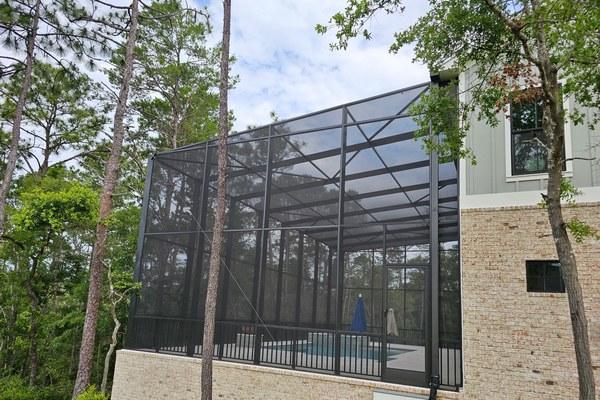
After Isaias: Check the License Before You Let Anyone Touch Your Enclosure
Part of our series on the 10 most common mistakes homeowners make after a hurricane damages their screen enclosure, pool cage, screen room, or patio cover.
They usually show up within a few days of the storm. A truck you don't recognize pulls up, someone knocks on the door, and they have a crew in the area, an opening this week, and a price that's only good if you sign today. After days without power and a backyard full of bent aluminum, it's tempting to say yes just to have one less thing to worry about.
Hiring the wrong crew is one of the most common mistakes we see after a hurricane, and it's one of the hardest to undo.
Why the license matters
In Florida, building or repairing the structure of a screen enclosure, pool cage, screen room, or patio cover is licensed work. A contractor licensed in another state still needs a Florida license to work on your home. And during a declared state of emergency like the one in effect for Isaias, unlicensed contracting goes from a misdemeanor to a third-degree felony.
That isn't just the contractor's problem. Hiring someone without a license puts you at risk too:
No permit, or the wrong kind. An unlicensed contractor can't pull a permit for the work, which can come back to bite you when you sell the house or file a claim after the next storm.
No insurance. If a worker is hurt on your property and their employer doesn't carry workers' comp, you could be the one facing the claim.
No one to call later. If the work fails, your only option may be to chase them in civil court, assuming you can find them.
Watch out for the owner-builder trick
One move we see after storms: the contractor asks you to pull the permit yourself as an "owner-builder." It sounds like a favor that saves you money. It isn't. Florida's own owner-builder form warns that unlicensed workers often use this to make it look as though the homeowner is doing the work. Once the permit is in your name, you're the responsible party, and you can be held liable for injuries to anyone working on your property.
A licensed contractor pulls the permit in their own name. If someone asks you to do it for them, that tells you what you need to know.
"If someone's knocking on doors with a deal that's only good today, that's your answer. A real contractor will still be here next week." — Eric Vanheteren, Aluminum Building Systems
Red flags to watch for
Door-to-door offers, especially from unmarked trucks or out-of-state plates
Pressure to decide today, often with a big discount to sweeten it
A business card or "occupational license" instead of a state contractor license. A business tax receipt is not a contractor license.
A request for you to pull the permit yourself
Cash only, or no written contract
A large deposit up front (our next post covers this one in detail)
An offer to handle your insurance claim for you (we'll cover that one too)
How to check a license in five minutes
Go to myfloridalicense.com or use the free DBPR mobile app, and search the contractor's name or license number.
Look at the license type. Florida contractors are either certified, which is valid anywhere in the state, or registered, which is valid only in the local areas where the contractor passed a competency exam. Certified license numbers start with "C," and registered numbers start with "R." Both are legitimate. If a license is registered, make sure it covers your county. For enclosure work, you're generally looking for a structural aluminum or specialty structure license, or a general, building, or residential contractor license.
Make sure it's active, and that the name on the license matches the company name on the contract and the truck.
Ask for proof of insurance, both general liability and workers' compensation.
If something seems off, report it. DBPR's Unlicensed Activity Hotline is (866) 532-1440.
Where to find a licensed contractor
Florida's Disaster Contractors Network, at DCNOnline.org, was set up by the state's licensing department to help homeowners find Florida-licensed contractors after a storm. It's free, and you can search by county. Being listed isn't a recommendation, so still check the license yourself and ask the questions in this post.
Is "out of area" always a bad sign?
No, and it's worth being fair about it. A Florida-licensed company from another part of the state can do good work here. Just ask the questions that matter: Do they know the wind-load requirements for your property? Do they know how permitting works in your county? Will they be around to stand behind the work after the storm traffic dies down?
"Ask anybody you're thinking about hiring who's going to answer the phone if something goes wrong a couple of years from now. That answer tells you a lot." — Eric Vanheteren, Aluminum Building Systems
When you're ready
Next in this series: After Isaias: Walk Away From a Contractor Who Wants to Handle Your Insurance Claim


